· ming · Guides · 8 min read
How to Price Handmade Items on Etsy: Formula
Add materials, labor, and overhead, then solve for a list price that keeps a target profit after the US listing fee, the 6.5% transaction fee, and 3% + $0.25 processing.
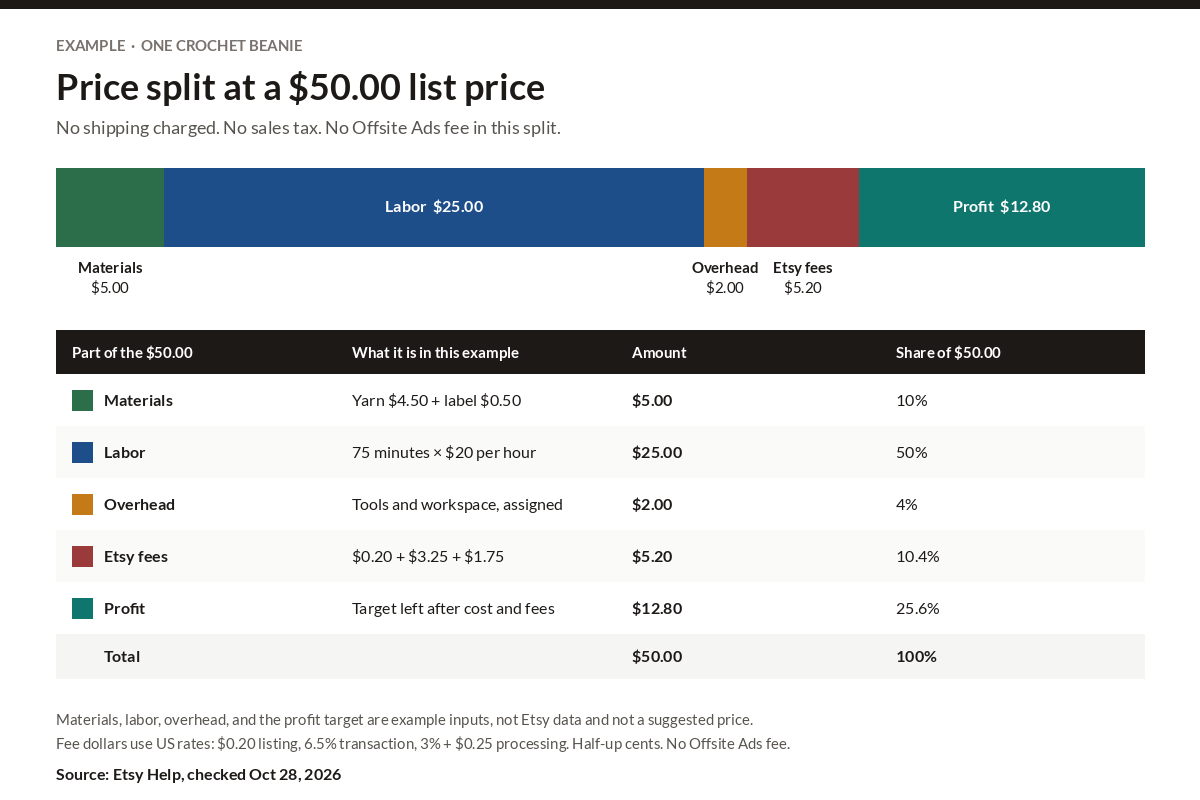
To price a handmade item on Etsy, add materials, labor, and overhead to get cost, add the profit you want to keep, then set a list price that still covers Etsy’s fees. As of October 28, 2026, a US one-item sale with no shipping and no tax uses a $0.20 listing fee, a 6.5% transaction fee, and processing of 3% plus $0.25. Hold that profit with (cost + target profit + $0.45) divided by 0.905.
This page is compiled from Etsy Help pages checked October 28, 2026; we did not upload test listings. Fee dollars below are arithmetic from those rates. The yarn, minutes, hourly rate, overhead, and target profit are example inputs, not Etsy prices.
Start from your cost
Start with cost, before any fee percent. Fee Basics names a listing fee, a transaction fee, and a payment processing fee. They come out of the list price.
- Materials + labor + overhead = cost.
- Add the profit you want that sale to leave.
- Solve for a list price that still covers the fees.
A common alternative starts from break-even = supplies + overhead + labor, then multiplies. That method is later on this page. This formula starts from a dollar profit and backs into the price. The example below is a crochet beanie.
Minutes times your hourly rate is the labor line
Labor is the minutes divided by 60, times an hourly rate you type in. This example uses 75 minutes at $20 per hour, which is $25.00. The $20 is an example input, not a recommended rate, and the profit figure is not an income forecast. A listing can sit unsold.
Fee Basics says the listing fee is $0.20 USD per listing, charged whether or not the item sells, plus another $0.20 for each extra quantity sold from that listing. The formula is one sale from a quantity-1 listing, so it includes one $0.20.
| Cost line | How this example counts it | Amount |
|---|---|---|
| Materials | Yarn $4.50 and a woven label $0.50 | $5.00 |
| Labor | 75 minutes × $20 per hour | $25.00 |
| Overhead | Tools and workspace assigned to this beanie | $2.00 |
| Cost | Materials + labor + overhead | $32.00 |
Overhead is an amount you assign to one item, such as a share of rent and equipment. This example uses $2.00 so the arithmetic stays visible. The target profit is $12.80, chosen so the no-ads price lands on $50.00.
Solve for the list price, not the profit
Here the unknown is the list price P. Cost and the profit target are already chosen.
Algebra for one US item with no shipping and no tax
- The bank account is in the United States, so payment processing is 3% + $0.25 USD. That page sets the rate by bank-account country.
- No shipping charge, no gift wrap, and no personalization charge.
- No sales tax in the example. The processing page says fees are taken from the total sale price, including shipping and any applicable sales tax. The Fees & Payments Policy says that if you sell from the US, the transaction fee will not apply to sales tax. With no tax and no shipping, each percent applies to P.
- One quantity, so one $0.20 listing fee.
- The regulatory operating fee is charged to sellers based in 9 countries, and the United States is not on that list, so that fee is left out.
- No Offsite Ads fee until the labelled case below.
fees = 0.20 + 0.065·P + (0.03·P + 0.25) = 0.095·P + 0.45
The 0.065·P is the 6.5% transaction fee, and the parentheses are US processing. Money left after cost and fees is 0.905·P − cost − 0.45. Set that equal to the target profit:
P = (cost + target profit + 0.45) / (1 − 0.095)
The $0.45 is $0.20 + $0.25, and 0.905 is 1 − 0.095. Each fee below is rounded half up to the cent. The Help pages checked for this article do not state a rounding rule, so a payment account can differ by a cent.
Crochet beanie at a $12.80 target profit
P = (32.00 + 12.80 + 0.45) / 0.905 = 45.25 / 0.905 = 50.00
| Fee | Arithmetic | Amount |
|---|---|---|
| Listing | Flat fee | $0.20 |
| Transaction | 0.065 × 50.00 | $3.25 |
| Payment processing | 0.03 × 50.00 + 0.25 | $1.75 |
| Total fees | $5.20 |
Check: 50.00 − 32.00 − 5.20 = 12.80. The chart splits that $50.00 into materials $5.00, labor $25.00, overhead $2.00, fees $5.20, and profit $12.80. For these fee lines on a price you already have, check the fee lines in our EverBee Etsy fee calculator walkthrough.
If the order comes from an Offsite Ad, add 15% of the sale amount. How Etsy’s Offsite Ads Work says the fee is 15% of the order total when a shop has always made less than $10,000 USD in any consecutive 365-day period, 12% at $10,000 USD or more in any such period, and never more than $100 USD on one order. The Fees & Payments Policy counts the display price plus shipping and gift wrap you charge, and, for a US seller, leaves sales tax out. Here the sale amount is P.
fees = 0.245·P + 0.45
P = (cost + target profit + 0.45) / (1 − 0.245) = (cost + target profit + 0.45) / 0.755
For this beanie, 45.25 / 0.755 = 59.933774… At $59.93, half-up rounding leaves $12.79. At $59.94:
| Fee | Arithmetic | Amount |
|---|---|---|
| Listing | Flat fee | $0.20 |
| Transaction | 0.065 × 59.94 | $3.90 |
| Payment processing | 0.03 × 59.94 + 0.25 | $2.05 |
| Offsite Ads at 15% | 0.15 × 59.94 | $8.99 |
| Total fees | $15.14 |
Check: 59.94 − 32.00 − 15.14 = 12.80. The 15% line is $8.99, under the $100 cap, so the 0.755 divisor fits. A shop on the 12% rate uses 0.12 instead of 0.15.
Etsy’s order earnings page also offers an Estimated earnings dropdown under Price & Inventory, and it says actual order earnings may vary.
Wholesale times two, then retail times two
A common keystone method is the other approach: break-even = supplies + overhead costs + labor, wholesale = break-even × 2 or more, and retail = wholesale × 2 or more.
On this beanie, break-even is the $32.00 cost, with fees kept out of it. Wholesale is $64.00. Retail is $128.00. The fee row uses the 6.5% transaction fee on Fee Basics as of October 28, 2026. No Offsite Ads fee is included.
| Line | Target-profit formula | ×2, then ×2 |
|---|---|---|
| Cost (materials + labor + overhead) | $32.00 | $32.00 |
| Wholesale (cost × 2) | Not a step in this formula | $64.00 |
| List price | $50.00 | $128.00 retail |
| Listing + 6.5% + US processing | $5.20 | $12.61 |
| Left after cost and those fees | $12.80 | $83.39 |
On $128.00 the fees are $0.20 + (0.065 × 128.00 = $8.32) + (0.03 × 128.00 + $0.25 = $4.09) = $12.61, and 128.00 − 32.00 − 12.61 = 83.39. The $50.00 price holds the $12.80 target. The $128.00 price is four times cost.
Etsy fee rates used here, as of October 28, 2026
Checked Oct 28, 2026.
| Fee | Rate used here | Etsy page |
|---|---|---|
| Listing | $0.20 USD per listing | Fee Basics |
| Transaction | 6.5% | Fee Basics |
| Payment processing, US bank account | 3% + $0.25 USD | Payment Processing Fees |
| Offsite Ads | 15% / 12%, maximum $100 USD per order | Offsite Ads |
| Regulatory operating fee | Charged to sellers based in 9 countries, including the UK (0.48%) and Canada (0.50%); the US is not on the list. | Regulatory Operating Fee |
Read other shops’ prices on the search page
To see what similar listings ask, sort an Etsy search by price using the steps in how to find a niche on Etsy. Search with the short phrases you would use as listing tags, so the results show items like yours.
FAQ
Where does the $0.45 in the price formula come from?
It is the $0.20 listing fee plus the $0.25 US processing flat fee. Those flats do not grow with P, so they sit in the numerator. The 6.5% and the 3% are the 0.095 in the divisor.
Why divide by 0.905 instead of adding 9.5%?
Etsy charges the transaction percent and the processing percent on the list price, which is larger than cost plus profit. Dividing by 0.905 raises the price until those percents, plus the $0.45 flats, still leave the target. Adding 9.5% onto cost plus profit uses a smaller base.
Does the ×2 ×2 retail price include Etsy fees?
Not in this example. The $32.00 cost has no fees in it, so the $128.00 retail price is cost × 2 × 2 before fees. The $12.61 beside it is this article’s arithmetic at the 6.5% transaction fee checked on October 28, 2026, plus US processing and the listing fee.
When does the $100 Offsite Ads cap replace the 15% term?
Offsite Ads caps one order at $100 USD. Use 0.755 only while 15% of the sale amount is inside that cap, as with this beanie’s $8.99. Above the cap, use a $100 Offsite Ads fee instead of 0.15·P: P = (cost + target profit + 0.45 + 100) / 0.905.
Is the $20 hourly rate in the crochet example a suggested wage?
Both the $20 and the 75 minutes are example inputs that make labor $25.00. Use your own minutes and rate. The $12.80 target was picked so the no-ads price lands on $50.00, and the formula does not say a buyer will pay it.
Put your own numbers into the same formula
The sequence is: cost from materials, labor, and overhead; a target profit you choose; then (cost + target profit + $0.45) / 0.905 for a US single-quantity sale with no shipping and no tax, as of October 28, 2026. An Offsite Ad at 15%, still under the $100 cap, uses 0.755 instead. Replace the beanie inputs with your own.